Key Takeaways
Pine and maple stumps are usually easier to grind than oak or sweetgum.
Sandy soil allows for shallower roots but may require soil stabilization after grinding.
Inland clay-rich soils need deeper excavation and better drainage planning.
Environmental conditions (wind, salt, flood zones) shape both how trees grow and how stumps behave after removal.
Understanding these conditions ensures you choose a stump removal method that’s effective, efficient, and safe for your property—not just today, but for the long run.
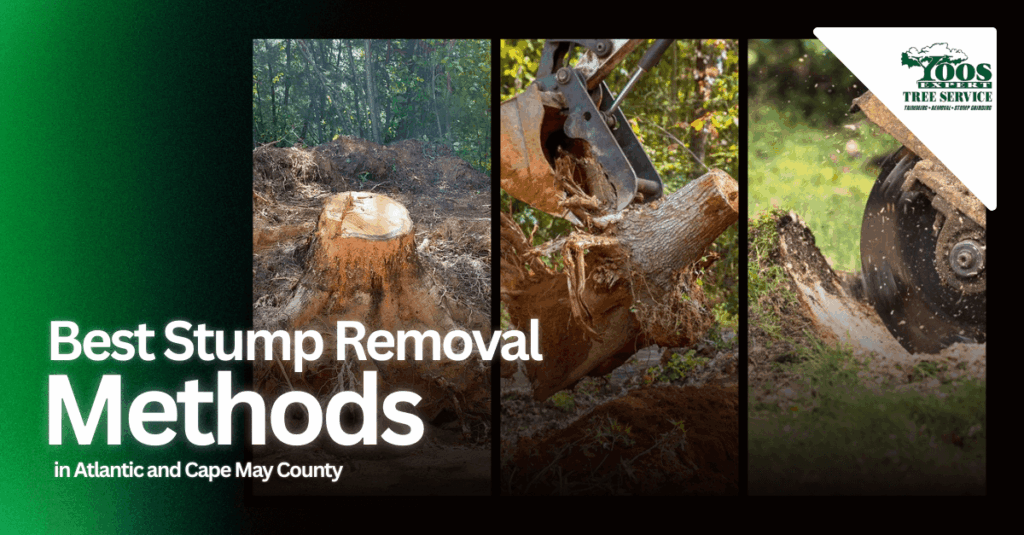
Removing a tree stump might seem like a small task, but if you’ve ever tripped over one or watched it sprout suckers every spring, you know it’s more than just an eyesore.
In Atlantic and Cape May County, where our landscapes range from sandy coastal lots to shady inland yards, stump removal isn’t just about making space it’s about protecting your property and keeping it beautiful.
Let’s walk through the best ways to get rid of those stubborn stumps, based on real-life local experience.
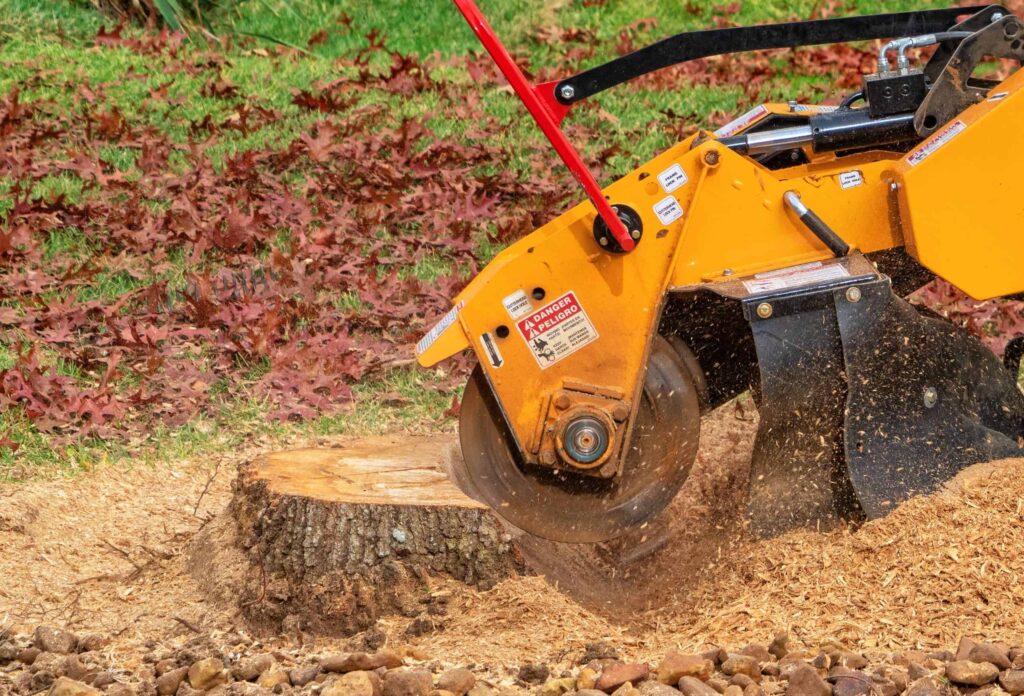
Here in South Jersey, stumps aren’t just ugly—they’re a hazard. Left in the ground, they can:
Attract pests like termites and carpenter ants,
Become a trip-and-fall risk, especially for kids and pets,
Interfere with lawn care and landscaping,
Even sprout unwanted growth from the roots.
Plus, with our high water tables and changing weather, stumps tend to rot unevenly, creating soft spots or sinkholes in your yard.
That’s why removing them the right way matters—especially in towns like Ocean City and Cape May where curb appeal counts.
When it comes to stump removal, one size doesn’t fit all—especially in a diverse region like South Jersey.
The trees we plant, the ground they grow in, and even the climate all influence how difficult it is to remove a stump.
Understanding the local ecosystem is the first step toward choosing the right removal method.
The types of trees most commonly found in Atlantic and Cape May Counties vary from coastal wind-resistant species to large shade trees in older inland neighborhoods.
Each species leaves behind a different kind of stump and root system that can either be simple or extremely stubborn to remove.
Root type: Deep taproots with strong lateral branches.
Removal difficulty: High – the roots penetrate deep into the subsoil, often requiring stump grinding or crane-assisted extraction.
Where common: Inland towns like Hammonton, Mays Landing, and older neighborhoods in Northfield.
Root type: Shallow, wide-spreading fibrous roots.
Removal difficulty: Moderate – easier to grind but can leave extensive root mats.
Where common: Along the coastal barrier islands and forested areas in Ocean View or Upper Township.
Root type: Aggressive and invasive with large surface roots.
Removal difficulty: High – the roots tend to regrow if not fully ground out, and can damage nearby pavement or foundations.
Where common: Mixed landscapes in Somers Point, Ventnor, and Egg Harbor Township.
Root type: Deep roots with strong water-seeking behavior.
Removal difficulty: Medium to high – tends to grow near drainage areas or low spots, which complicates excavation.
Where common: Often planted along city streets or parkways in Margate and Cape May.
Root type: Shallow, fast-growing roots that can spread far from the base.
Removal difficulty: Moderate – easy to grind but regrowth is common without proper disposal.
Where common: Found in both urban and suburban yards across Linwood, Ocean City, and Pleasantville.
Each tree not only leaves a different type of stump, but the roots they’ve developed over decades can challenge even experienced arborists if the surrounding ground isn’t cooperating.
The soil under your tree stump plays a huge role in how easily it can be removed.
Characteristics: Light texture, drains quickly, low in organic matter.
Effect on stumps: Roots tend to spread out wide instead of deep, especially near the beach or salt marshes. While this might seem like it makes removal easier, sandy soils can shift, making stump grinding slightly unstable without proper leveling.
Considerations: Equipment must be leveled carefully; erosion after removal is a concern.
Characteristics: Heavier, holds water, rich in nutrients but dense.
Effect on stumps: Tree roots here often grow deeper and become compacted into the clay, especially in older trees. This makes manual digging or chemical removal difficult.
Considerations: In areas like Hammonton and Egg Harbor City, roots may entangle with underground utilities or sprinkler systems buried just below the clay layer.
South Jersey’s coastal environment adds another layer of complexity. These factors shape both tree growth and stump decay.
Trees closer to the ocean develop salt-resistant root systems that may be stunted or hardened. This can cause delayed natural decay of the stump after removal.
Trees like red cedar and black locust, often used as windbreaks near Wildwood or Sea Isle City, leave behind very resilient stumps that don’t rot easily.
Trees exposed to strong winds grow with asymmetrical root systems—more roots on the windward side. This can make stump grinding uneven and risky if not done by a trained expert.
Wind-thrown trees also leave behind disturbed soil and exposed root plates, which need careful backfilling.
In areas prone to tidal flooding or heavy rain, like parts of Cape May Point or Avalon, tree stumps may be waterlogged and rot inconsistently.
These environments also encourage fungal growth and soil instability, both of which can complicate replanting or landscaping after removal.

Tree stump removal isn’t a one-method-fits-all situation. Depending on the type of tree, its root system, your landscape, and access to equipment, some methods work better than others.
In South Jersey, where sandy coastal lots contrast sharply with compact inland soil, your choice can make or break your landscaping plans.
Here are the most common—and effective—ways to remove tree stumps in Atlantic and Cape May Counties, broken down in detail:
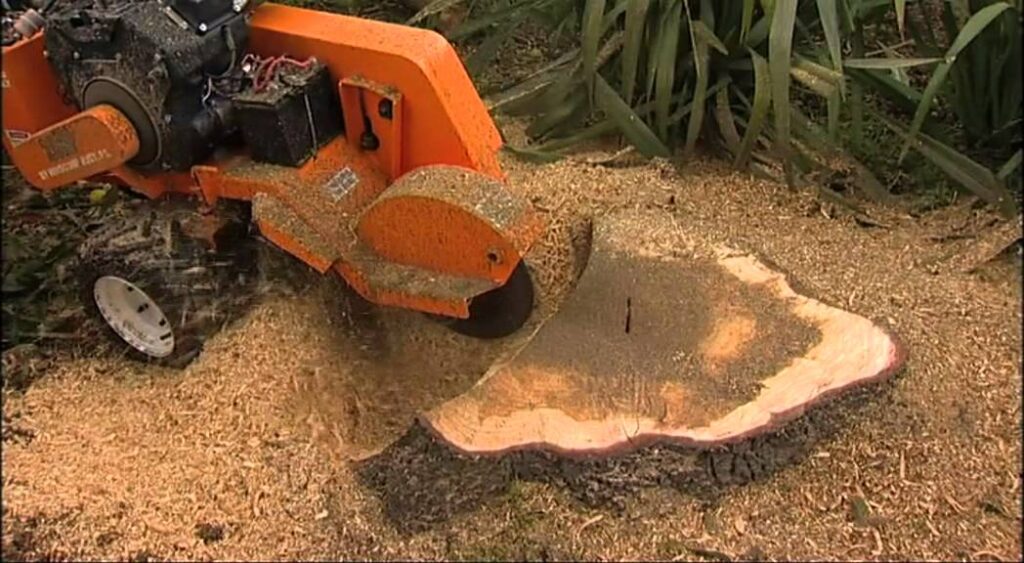
Stump grinding is by far the most popular stump removal method used by professionals in South Jersey—and for good reason.
A stump grinder is a powerful machine equipped with a rotating cutting wheel lined with carbide teeth.
It grinds the stump down into fine wood chips, usually 6 to 12 inches below the soil line—deep enough for planting grass or another tree.
Advantages:
Fast and clean: Most stumps are ground down in under an hour.
Minimal disruption to surrounding landscape.
Leaves behind a mulch-like byproduct that you can use in flower beds or compost.
No large hole is left behind, unlike full excavation.
Considerations:
Doesn’t remove roots—so some regrowth is possible, especially with aggressive species like sweetgum or willow.
Machinery may not fit in tight urban spaces or fenced yards.
If not leveled properly, it can leave a small depression in the ground over time.
Best for:
Homeowners in Ocean City, Northfield, and Somers Point.
HOAs and public parks with frequent landscaping needs.
Sites where tree roots are shallow or non-invasive.
Chemical stump removal is a method used when time is not a pressing concern, and the goal is to accelerate natural decomposition.
It involves drilling multiple holes in the top and sides of the stump, filling them with a chemical solution most commonly potassium nitrate and then waiting for nature to take its course.
Over several weeks or months, the wood becomes soft and spongy, making it easier to break apart manually or burn.
Advantages:
Quiet and non-invasive—no machinery needed.
Low cost, especially for multiple small stumps.
Works in tight spaces or fenced yards where machines can’t fit.
Considerations:
Takes 4–8 weeks or longer, depending on tree type and weather.
Some chemicals are restricted in environmentally sensitive areas (e.g., wetlands, coastal zones).
Must be kept away from children, pets, and water sources.
Best for:
Small stumps from pine, birch, or young maples.
Locations with limited access like backyards in Ventnor, Margate, or Cape May Point.
Homeowners not in a rush and seeking a low-labor option.
Legal Reminder:
In towns like Margate and Ventnor, chemical stump removers may be regulated near groundwater recharge zones or stormwater management areas.
Always check with your local environmental or zoning office.
Manual stump removal is the most labor-intensive method, but it can be effective for small or shallow-rooted trees.
Using hand tools like a shovel, mattock, digging bar, handsaw, and axe, the goal is to expose the stump’s root ball and sever it from the ground.
Advantages:
Low to no cost—just your time and tools.
Total control over the process.
No chemical use or machinery required.
Considerations:
Backbreaking labor, especially in clay-heavy soil like that in Hammonton or Mays Landing.
Risk of damaging irrigation or underground utilities.
Incomplete removal may lead to regrowth or sinkholes.
Best for:
Homeowners with small pines, cedars, or ornamental trees.
DIY enthusiasts with the time, strength, and patience.
Removing tree stumps in garden beds or near patios where precision matters.
Not recommended for:
Oak, hickory, or sweetgum stumps with deep taproots or aggressive lateral roots.
Soil with high compaction or rock content.
When the stump is too large, too deeply rooted, or located in a hazardous or limited access area, a knuckle boom crane is the best solution.
This method uses a truck-mounted articulated crane that lifts the stump (or even an entire tree) vertically, without dragging it across the yard.
At Yoos Tree Service, this is one of the specialties—especially for storm cleanup and municipal projects.
Advantages:
Can handle giant stumps or multi-stump systems.
Ideal for locations with obstacles, such as fences, buildings, pools, or septic tanks.
Quick, precise, and safe—reduces yard damage compared to dragging equipment.
Considerations:
Higher cost due to the size of the equipment and crew.
Requires space for crane operation and may need permits or traffic control in urban areas.
Not necessary for small or medium-sized stumps.
Best for:
Commercial sites, municipal lots, and storm-damaged areas in Atlantic City, Linwood, and Ocean View.
Homes with tight access driveways or dense landscaping.
Emergency removals where underground pipes or gas lines must be avoided.
Burning a stump is an old-fashioned method that’s rarely recommended in modern residential or urban areas, especially in coastal New Jersey where fire codes are strict.
The process involves hollowing out the stump, filling it with combustible material (like charcoal or kerosene), and lighting it. Over hours—or days—it burns out from the center, reducing the stump to ash.
Advantages:
Effective in very remote or rural locations.
Doesn’t require digging or chemicals.
Considerations:
Extremely risky in dry seasons or pine-heavy areas due to fire spread potential.
Most townships prohibit open burning without special permits.
Air quality concerns near coastal zones, protected lands, or senior housing communities.
Best for:
Farmland or remote woodland properties with ample clearance and firebreaks.
Landowners familiar with local burn laws and safety measures.
Fire Safety:
Always call your local fire marshal or township code enforcement.
Never use gasoline or accelerants.
Keep a hose, extinguisher, and shovel nearby at all times.
Stump removal may seem like a straightforward task, but in South Jersey, it’s not always as simple as grabbing a chainsaw or renting a grinder.
Depending on where you live—whether it’s Margate City, Ocean City, Cape May, or anywhere in between—there could be specific rules or permits you need to follow before removing a tree stump from your property.
These local regulations are in place to protect natural resources, underground utilities, community aesthetics, and sometimes, even historical or environmental zones.
Ignoring them could result in fines, legal delays, or denied property improvements.
Here’s what every homeowner, landscaper, or contractor should know before beginning stump removal in Atlantic and Cape May Counties:
In some South Jersey municipalities, you may need a tree removal permit—even if the tree is already down and only the stump remains.
When Permits Are Typically Needed:
If the stump is part of a tree located in a protected zone, such as:
A conservation easement
Floodplain or wetland buffer (common in Ocean City, Wildwood, and Cape May Point)
Near public sidewalks or utility easements
If the tree was removed without a prior permit, and now you’re grinding the stump to finish the job.
If the property is in a designated historic district, which may restrict landscaping changes.
Example:
In Ocean City, NJ, removal of any tree over a certain diameter on private or commercial property often requires a Zoning or Forestry Department notification—even if it’s only the stump being removed.
Pro Tip: Always check with your town’s Code Enforcement or Planning Department to find out whether you’re in a regulated area.
If your property is located within a planned unit development (PUD) or gated community like those found in Linwood, Mays Landing, or Upper Township, your HOA may have its own landscaping rules.
Common HOA Rules Include:
Prior written approval for tree or stump removal from your front yard or visible landscape.
Specific tree species that must be preserved or replaced.
Guidelines for how quickly stumps must be removed after tree damage or storms.
Approved vendors list—only licensed, insured tree services may be allowed to work on HOA-managed land.
Why It Matters:
Failing to follow HOA rules can lead to violation notices, fines, or even liens placed on your property for non-compliance. HOAs often prioritize aesthetic uniformity and safety, so removing a stump improperly can result in community disputes.
Both Cape May and Atlantic Counties have areas that fall under NJDEP (New Jersey Department of Environmental Protection) or federal wetland regulation zones, especially around marshlands, coastal lagoons, and flood-prone zones.
Situations That Require Extra Caution or Permits:
Removing a stump within 50–150 feet of a regulated wetland, bay, or stream.
Stump grinding in dune-protected zones (e.g., Sea Isle City, Avalon, or Longport).
Burning or using chemical stump removers in areas where runoff could affect water quality.
Tree root removal near erosion-prone slopes, which may destabilize ground structure.
Governing Bodies That May Be Involved:
NJDEP Division of Land Use Regulation
Cape May County Planning Board
Atlantic County Soil Conservation District
Permits May Include:
CAFRA Permit (Coastal Area Facility Review Act)
Freshwater Wetlands General Permit
Soil Disturbance Notification
Before digging out a stump—especially manually or with excavation tools—you are legally required to call 811, the New Jersey One Call System, to mark out any underground utilities.
This includes:
Gas lines
Water mains
Sewer pipes
Fiber optic or electric cables
Why This Is Critical:
Accidentally hitting a gas line or underground utility while removing a stump could be extremely dangerous, not to mention expensive and potentially criminal. You are liable for any damage caused by failure to notify.
It’s free to call 811 and have your property marked. The markings usually appear within 3 business days.
If you’re considering burning out a stump—which is rare and discouraged—you’ll need to comply with both state and local fire codes.
In Most Townships:
Open burning is prohibited without a specific burn permit.
Burning in coastal zones is heavily restricted due to dry pine forests, risk of wildfire spread, and air quality controls.
Any stump-burning attempt must be controlled, supervised, and far from structures or flammable materials.
Call your local fire marshal before proceeding—some towns will require written permission, and others may prohibit it entirely.
Skipping the permit process may result in:
Code violations
Cease-and-desist orders
Fines up to several hundred dollars
Required replanting or restoration work
HOA-related liens or legal action
In some cases, homeowners have had to restore removed trees at their own cost, especially in environmentally protected areas.
Not every stump needs removal right away. Some homeowners choose to leave them for:
Natural decay (takes years),
Decorative purposes like planters or birdbaths,
Budget reasons, especially when the stump is in a non-visible part of the yard.
But be careful—decaying stumps attract fungi, beetles, and burrowing animals. If you’re unsure, a certified arborist can inspect and recommend the safest option.
Prices vary depending on size, location, and access:
| Stump Type | Average Cost |
|---|---|
| Small (under 12”) | $100–$200 |
| Medium (12”–24”) | $200–$350 |
| Large (24”+) | $400–$600+ |
| Crane-Assisted Removal | $600–$1,200+ |
Want to know what each option actually costs? Check our complete guide to tree removal pricing in Atlantic & Cape May County for detailed cost ranges based on stump size, method, and service type.
If you’re staring at an old tree stump in your backyard, it’s tempting to think: “I can handle this myself.” And in some cases, you might be right—DIY stump removal can be a satisfying, low-cost option.
But here in Atlantic and Cape May Counties, with our dense tree roots, tight neighborhoods, sandy soils, and old infrastructure, stump removal isn’t always as simple—or as safe—as it seems.
Let’s break down the real pros and cons of DIY stump removal versus hiring a certified professional arborist, especially in the unique environmental and legal landscape of South Jersey.
For smaller stumps or softwood trees, DIY removal can be a good weekend project—if you know what you’re doing and have the right tools. But it also comes with real risks.
Benefits of DIY Stump Removal
• Lower upfront cost if you already own tools
• No need to coordinate with a contractor or crew
• Satisfying hands-on project for homeowners who enjoy yard work
• Can work well for small, shallow-rooted stumps in open areas
Downsides of DIY Stump Removal
• High risk of injury — Chainsaws, axes, and rented stump grinders can be dangerous without training
• Physically demanding — Digging and cutting through roots is hard work, especially in clay-heavy soil common in areas like Mays Landing or Hammonton
• Utility hazards — You must call 811 before digging to avoid hitting buried gas, electric, or water lines
• Incomplete removal — Without professional equipment, you may leave roots behind that:
• Continue to sprout
• Attract pests and fungi
• Cause your lawn to sink over time
• Equipment rental costs add up — Renting a grinder, safety gear, or trailer can quickly outweigh the savings
• No warranty or cleanup — You’re on your own for haul-away, ground leveling, or lawn repair
Professional arborists are trained, certified, and insured to handle all types of tree and stump removal safely and efficiently. They don’t just bring experience—they bring peace of mind.
Advantages of Hiring a Certified Arborist
• Proper assessment of root structure and soil type to determine the best removal method
• Specialized equipment like stump grinders, knuckle boom cranes, and root extractors for tight-access or heavy-duty jobs
• ISA-certified expertise in tree biology, decay patterns, and safe grinding depth
• Full insurance coverage that protects your home and property
• No physical labor for you — The crew handles everything
• Clean-up and restoration included — Most pros will mulch, backfill, and even reseed the area
• Knowledge of local laws and HOA rules to ensure compliance with city codes or neighborhood guidelines
• Permit assistance — Some services will pull the necessary permits for you in towns like Ocean City, Cape May, or Ventnor
| Feature | DIY Removal | Professional Arborist |
|---|---|---|
| Cost | Lower upfront, but can add up | Higher upfront, all-inclusive |
| Risk of Injury | High (tools, digging, equipment) | Very low (trained & insured) |
| Equipment Needed | Must rent or own tools | Provided by the company |
| Time Required | Hours to days | Often under 1–2 hours |
| Permit Help | You’re on your own | Handled by the company |
| Result Quality | Varies – may leave roots or hole | Clean, safe, and level ground |
| Utility Marking | You must call 811 | They handle it |
| Landscaping Advice | Limited | Professional guidance |
Removing the stump is just step one. Afterward, consider:
Backfilling the hole with clean soil or topsoil
Seeding or sodding the area to prevent erosion
Mulching with stump chips (if pest-free)
Replanting a new tree, but in a slightly different spot to avoid leftover roots
If the roots were invasive (like with sweetgum or Norway maple), give the soil a rest or plant shrubs or groundcovers with shallow roots.
If you’re in Cape May, Atlantic City, Somers Point, Egg Harbor Township, or anywhere in between—help is just a call away.
Yoos Tree Service has been removing stumps, trees, and hazards across South Jersey for over 38 years. With certified arborists, crane services, and 24/7 emergency response, they’re trusted by:
Homeowners,
HOAs,
Contractors,
And local municipalities.
Whether you’re tackling a small stump in your backyard or a major rootball from a storm-felled oak, the right method depends on your goals, budget, and landscape. Know your options, respect local laws, and when in doubt—call in the experts.
Because a flat, stump-free yard isn’t just prettier. It’s safer, easier to maintain, and ready for whatever you plant next.
Share: