Key Takeaway
Tree removal in Atlantic and Cape May Counties typically takes anywhere from 1 to 10 hours, depending on the size, type, and location of the tree, as well as local permit requirements and weather conditions.
Smaller trees in open areas can be removed quickly, while large or hazardous trees near structures may require crane equipment and take a full day or more.
Emergency services—especially after storms—can often be completed the same day with the right crew and tools.
Homeowners should also factor in stump grinding and debris cleanup, which may add extra time. Understanding these variables helps set realistic expectations and ensures a smoother, safer removal process.
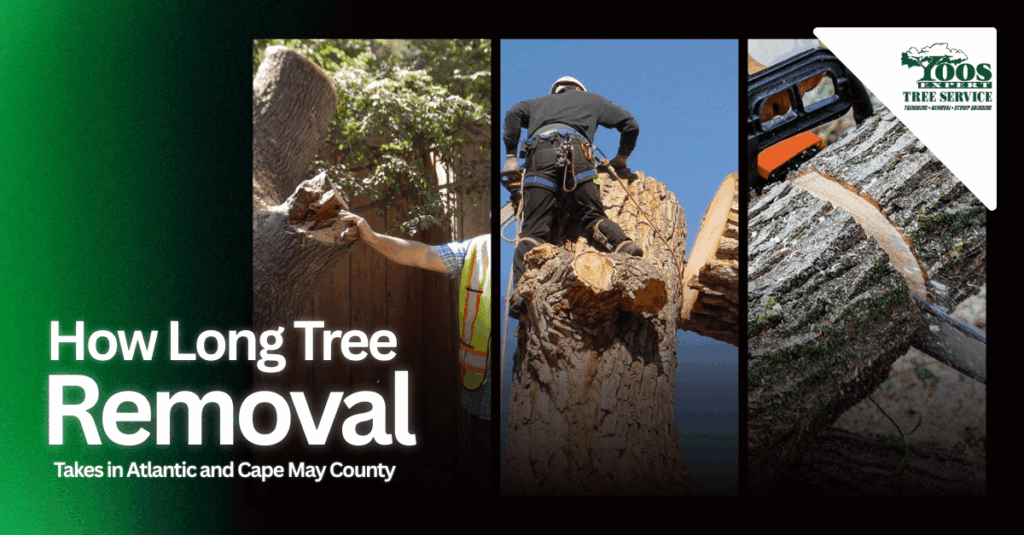
Tree removal isn’t something most folks think about until it’s urgent—like after a storm, or when a leaning tree suddenly looks like it’s ready to fall on your house.
One of the first questions people ask me is, “How long will it take to remove this tree?”
The short answer: it depends. The longer answer? Well, let’s break it down for you.
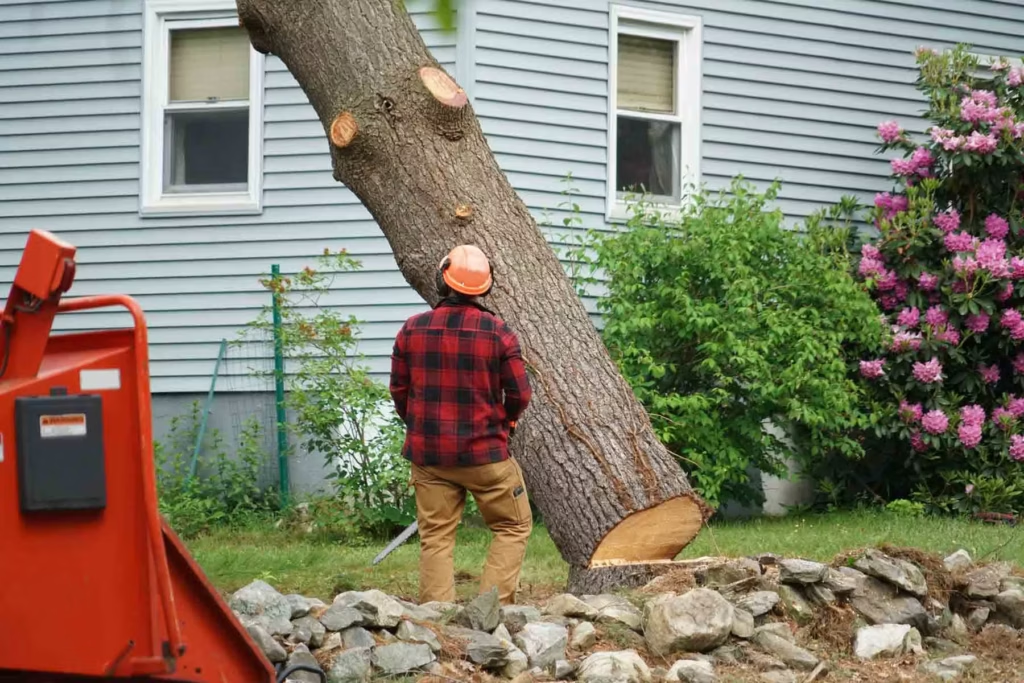
Removing a tree may seem simple, but many variables can affect how fast or slow the process goes. From tree size to local soil conditions, every detail plays a role in the total time it takes to complete the job.
Whether you’re dealing with a dying tree in Margate or storm damage in Ocean City, here’s what influences the timeline the most.
The bigger the tree, the longer it takes—plain and simple. A massive oak with a wide canopy and thick limbs can take several hours or even a full day to cut down and remove safely.
In contrast, a smaller ornamental tree like a crepe myrtle or dogwood might be removed in under an hour. Species also matter.
Some trees, like hickories and maples, have extremely dense wood that takes more effort to cut through. Others, like pine, are softer but taller and often harder to dismantle near structures.
The complexity of the root system is another factor—trees with deep or sprawling roots can delay stump grinding or cleanup. Understanding tree biology helps our crew estimate the time needed and choose the right tools for the job.
Where the tree is located on your property makes a huge difference. A tree growing close to a house, garage, or power lines will always take more time to remove safely compared to a tree standing out in an open backyard.
Limited access—like narrow gates, steep slopes, or soft ground—can delay setup and restrict the use of large equipment. In coastal towns like Cape May, sandy or unstable soil can make it harder to anchor cranes or trucks.
Urban forestry jobs also require extra care to avoid damaging nearby buildings, fences, or driveways. Every job site is different, and site access logistics can add hours to an otherwise straightforward removal.
Not all tree removals are created equal—some need basic chainsaws and climbing gear, while others call for heavy-duty machinery.
When a tree is too large or too risky to climb, we use our knuckle boom crane, which allows us to safely and quickly remove trees from tight spots or lift heavy limbs over structures.
This specialized equipment can speed up the process dramatically, especially in emergency or storm-damaged situations. Without a crane, large or hazardous trees have to be removed in small sections, which is labor-intensive and time-consuming.
Equipment selection is a major part of the planning process and directly affects how fast we can get the job done.
Mother Nature doesn’t always cooperate. Tree work is heavily dependent on weather, and poor conditions can slow everything down—or halt it entirely. High winds make it dangerous to climb trees or operate cranes.
Rain and wet soil can cause trucks or machinery to sink or become unstable. Snow and ice add even more hazards, especially when working near power lines or elevated platforms.
Safety is always our top priority, so if the forecast turns sour, we may have to pause or reschedule for everyone’s well-being. Even light weather delays can push the timeline out by hours or days, especially during the busy storm season in South Jersey.
The time it takes to remove a tree isn’t one-size-fits-all. It depends on several variables like height, diameter, location, and health of the tree, along with whether stump grinding and debris cleanup are included.
But if you’re just looking for a ballpark estimate, breaking it down by tree size is a great starting point. Let’s take a closer look at each size category and what you can realistically expect in terms of removal time in Atlantic and Cape May Counties.
Small trees are the quickest to remove, especially if they’re in open spaces with easy access. These trees usually have thinner trunks, lighter limbs, and smaller root systems, making them ideal for a fast removal.
Common examples include dogwoods, cherry trees, crepe myrtles, young maples, and crabapples.
In a best-case scenario—no obstacles, no fencing, no power lines—a small tree can be taken down in as little as 45 minutes.
But even for simple jobs, we take the time to work safely, which means cutting the tree down in sections, lowering limbs carefully, and using the proper rigging techniques.
If the tree is close to a structure, or if we’re also grinding the stump and removing all debris, expect it to take closer to 2 hours. This size range is common for front-yard removals or landscape changes.
Medium-sized trees are more complex and require more time and manpower. These are trees like mature birches, maples, ash, smaller pines, and some ornamental oaks.
They often have thicker trunks, denser foliage, and more extensive root systems. In many residential neighborhoods across Egg Harbor Township, Northfield, and Ocean City, these are the most common tree sizes we deal with.
These trees usually need to be cut in stages—from removing the canopy to carefully sectioning the trunk as we work down. We often use rigging systems or even our crane, depending on where the tree is located. If the tree is near a house, deck, fence, or power line, we’ll slow down for safety and precision.
Expect 3–4 hours for straightforward removals with good access. If we need to bring in specialized equipment or navigate tight spaces, the timeline pushes closer to 5 hours. Add another 1–2 hours if you’re including stump grinding and full yard cleanup.
Large trees are an all-day job—sometimes even a two-day process if the tree is unusually hazardous or difficult to reach.
These giants often include large oaks, mature spruces, tall pines, and sycamores. We see a lot of these in older neighborhoods, coastal properties, and rural areas like Hammonton or Cape May Court House.
These jobs often require the use of a knuckle boom crane, especially if the tree is leaning, partially rotted, or dangerously close to structures.
With a crane, we can remove large limbs and trunk sections safely and more efficiently. Without it, the job is slower and done in smaller, manageable pieces.
In perfect conditions, a large tree with full access may take 6–7 hours to bring down and remove. But if the tree is damaged, tangled in utility lines, or has to be removed from a tight urban lot, it can easily stretch into 10 hours or more.
These jobs often include a multi-person crew, large trucks, and a separate day for stump removal and final grading.
Sometimes, tree removal takes longer than expected due to these common issues:
Storm damage: Trees that have already fallen or been split by high winds are unstable and require extreme caution. Emergency removals after hurricanes or nor’easters can take an entire day, especially with cleanup.
Tangled in utility lines: If the tree is caught in power or cable lines, we often need to coordinate with the utility company. This can delay removal by several hours—or days—depending on response time.
Dead or rotted trees: These are structurally unstable and can’t be climbed. We may need to rely solely on cranes, which adds setup time and requires extra care during dismantling.
Multiple trees: If you’re removing several trees from one property, it adds time but can often be more efficient than doing each job separately.
In towns like Egg Harbor Township, Mays Landing, or Hammonton, tree removals vary based on the neighborhood. Many homes here have older trees, and some properties are tight.
Expect:
Heavier traffic on job days in urban areas like Ventnor or Margate
More permits or HOA approvals in community neighborhoods
Easier access in rural zones like Buena or Weymouth
We’ve worked with local municipalities and homeowners for decades, so we know how to move quickly and safely through these areas.
Cape May County brings its own challenges. Towns like Ocean City, Wildwood, and Stone Harbor often have stricter ordinances. If you’re near the water or in a protected area, you may need permits before we can start.
Historic zones may delay scheduling due to regulations
Beach homes often have limited access, requiring crane work
Some towns require tree replanting after removal
That’s why we help you handle permits—so you’re not stuck waiting around.
When a storm rolls through South Jersey, everything can change in seconds. Trees that stood strong for decades can snap, split, or fall—taking out fences, blocking roads, crushing cars, or, worse, crashing into homes.
In moments like that, time is not on your side. You need fast, skilled, and safe emergency tree removal. But how quickly can help really arrive?
The short answer is: very quickly—if you’re working with the right company. At Yoos Tree Service, we’ve been handling emergency tree calls in Atlantic and Cape May Counties for nearly four decades. We know how to move fast, because in these situations, every minute counts.
In most emergency scenarios, we aim to arrive on-site the same day you call—often within hours. Whether it’s early morning, late evening, or a weekend holiday, our 24/7 emergency crews are always on standby.
We keep our trucks and crane equipment ready to roll because when trees fall, especially in densely built areas like Ventnor or Ocean City, delays can cause further damage or danger.
For example, if a massive pine has fallen across your driveway and is leaning dangerously against your home, we prioritize that call as high-risk. We’ll dispatch a certified crew to assess the scene, secure the area, and begin safe dismantling immediately.
Here’s what typically happens during a tree emergency:
You call us and provide basic details (location, damage, safety risks).
A crew is dispatched immediately, often with a foreman and a crane operator.
We assess the site for hazards: live wires, structural damage, unstable limbs, etc.
The tree is stabilized, often using rigging or crane lift.
We begin sectional removal, prioritizing areas that pose immediate threats.
Debris is cleared, and we provide emergency tarping or temporary covers if needed.
A follow-up is scheduled for full cleanup or stump grinding, if necessary.
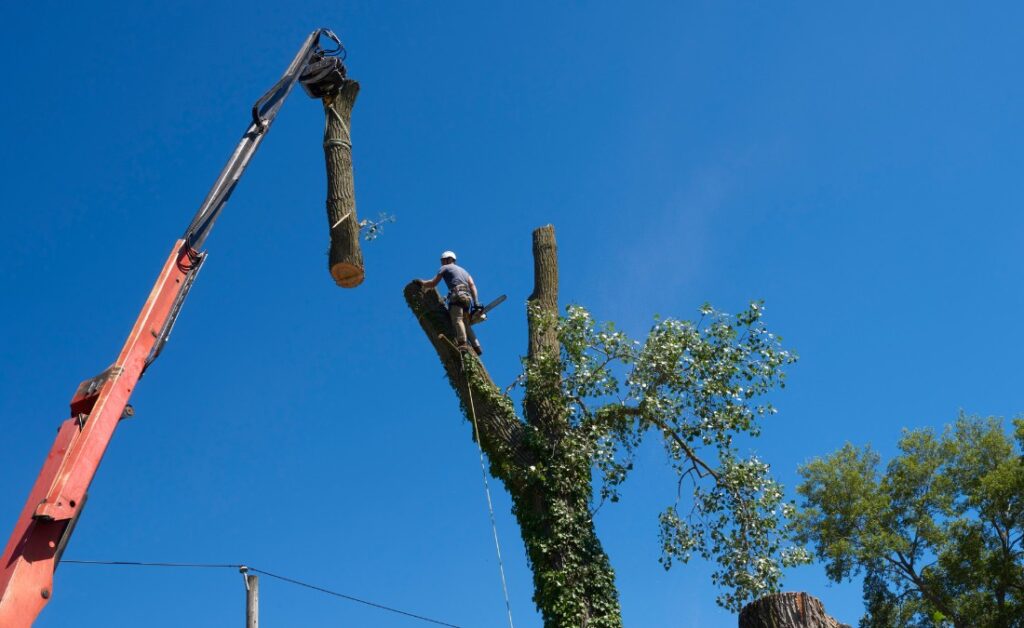
In emergency situations, we often use our knuckle boom crane to access hazardous limbs or remove heavy trunks safely—especially when climbing isn’t safe due to storm damage or structural instability. Cranes allow us to:
Remove sections without further damaging roofs, siding, or decks
Work safely around utility lines or narrow city lots
Lift debris over buildings or fences without dismantling landscaping
This advanced equipment saves time and reduces risk—both to your property and our crew.
We’ve seen it all, but these are some of the most frequent scenarios we get called for after a storm or high-wind event:
Trees that have fallen on homes or garages
Large limbs blocking driveways, roads, or entrances
Trees leaning or cracked, posing an imminent collapse threat
Uprooted trunks interfering with underground utilities
Split trees that need to be cabled, braced, or fully removed
Whether you’re in downtown Cape May or a wooded area in Mays Landing, the risks are the same—and quick action matters.
In many cases, yes. Most homeowners insurance policies will cover emergency tree removal if the tree caused damage to a structure, like a roof, fence, or driveway.
We provide documentation, photos, and detailed invoices to help you file a claim. If you’re unsure what’s covered, we can assist you in communicating with your insurance provider or contractor.
One of the most dangerous things a homeowner can do is try to cut or move a storm-damaged tree themselves.
After a major storm, trees are often under extreme tension, tangled in power lines, or structurally compromised. One wrong cut can cause a branch to swing violently or a trunk to roll.
Our team is trained in tree hazard mitigation, storm risk assessment, and emergency rigging. Every decision we make on-site prioritizes your safety and protects your property.
The best way to handle an emergency is to prevent one. Here are a few proactive steps you can take:
Schedule an annual tree health inspection, especially before hurricane season.
Remove dead or weakened trees early—don’t wait until they fall.
Install cabling or bracing on structurally questionable trees.
Keep a trusted tree removal company like ours saved in your phone.
We recommend calling us for a tree risk assessment if you notice leaning trunks, hollow spots, fungus at the base, or large dead limbs.
Yes, in many cases, tree removal permits can delay the process—especially if you live in a township with strict environmental regulations or if the tree is considered protected under local codes.
While not every removal requires paperwork, it’s becoming more common for municipalities in Atlantic and Cape May Counties to enforce tree ordinances, especially in coastal or historic areas.
Let’s break down when a permit is required, how long it can take, and what you can do to speed up the process.
Permits are generally required when:
The tree is in the front yard or public right-of-way
The tree is over a certain size, often measured by DBH (diameter at breast height), usually 8–24 inches depending on town
Your property is in a historic district, coastal zone, or wetland buffer
You’re removing more than one tree at once (especially for developers or large properties)
The tree species is protected, such as native oaks or other significant trees
You’re part of an HOA that has landscaping regulations
In some towns like Ocean City, Margate, or Cape May, you might even need a permit just to trim or prune a tree if it’s near a sidewalk or street.
Others—like Egg Harbor Township or Mays Landing—are more lenient but still require a permit for larger trees or anything close to power lines or public infrastructure.
The permit process can add anywhere from 2 days to 2 weeks, depending on the township. Here’s what typically happens:
You (or your contractor) submit a permit application to your local code enforcement or public works department.
The town may require an on-site inspection by a municipal arborist or zoning officer.
If your property is in a regulated area, such as a flood zone, coastal zone, or environmentally sensitive area, additional reviews may be needed by environmental departments.
Once approved, the town issues the permit, usually with conditions like tree replacement or limitations on equipment access.
Some towns only meet once per week or bi-weekly to review permits, which can further delay the process.
Removing a tree without the required permit can result in hefty fines, mandatory tree replacement, or even legal action—especially in historic zones or areas near the coast.
For example, removing a mature tree in Cape May’s Historic District without approval could result in hundreds to thousands of dollars in penalties, plus the cost of replanting.
Homeowners are often surprised to learn that even dead trees may require documentation before removal—especially if there’s concern that the death was due to neglect or construction damage.
We’ve worked with dozens of townships and municipalities across South Jersey, and we understand how to streamline the permit process. Here’s how we help:
We’ll check local ordinances for you before we start the job, so there are no surprises.
If a permit is needed, we can handle the paperwork on your behalf or guide you through the submission process.
We maintain relationships with local code officials, arborists, and zoning departments, which often speeds up approvals.
If there are complications—such as disputes with neighbors, shared trees on property lines, or overlapping jurisdiction—we help coordinate with all parties to avoid delays.
This is especially helpful for clients in towns with more complex or formal processes like Ventnor, Northfield, or Cape May Point.
We’ve been removing trees in Atlantic and Cape May Counties for over 38 years, and we’ve learned how to make things smooth and fast:
ISA-certified arborists assess the situation quickly
Knuckle boom crane handles tough removals efficiently
Local knowledge helps us navigate ordinances, traffic, and tree types
We don’t just show up and start cutting. We plan every job with safety, speed, and cleanliness in mind.
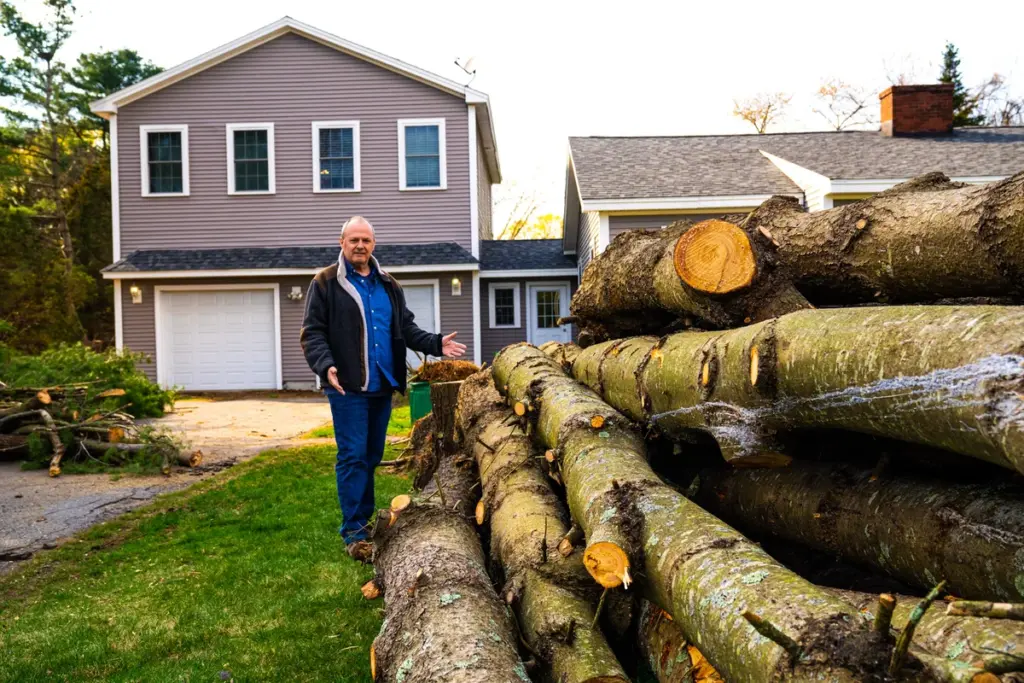
Somers Point: Emergency Oak Removal
After a nor’easter, a massive oak was leaning toward a home. We were there within hours. The full job—including limb removal and cleanup—took about 7 hours, thanks to our crane team.
Cape May Court House: Backyard Maple
A 35-foot maple growing too close to a fence came down in under 2.5 hours. Stump grinding was done the next morning.
Not always, but it helps if we need to confirm access or talk through safety concerns.
Often, yes—but if it rains or the soil is too soft, we may need to return.
We haul everything away unless you want to keep the woodchips or firewood.
If you’re in Atlantic or Cape May County and wondering how long your tree removal will take, the best step is to get a custom quote. We’ll take a look at:
Tree size and condition
Location and access
Equipment needed
Local regulations or permits
We offer free estimates and always explain the full process so you’re never left guessing.
Tree removal doesn’t have to be stressful. Whether it’s a small tree in your backyard or a huge oak threatening your roof, we’ve got the crew, the equipment, and the experience to handle it safely—and fast.
If you’re in South Jersey, give us a call. We’re here 24/7 and ready to help protect your home and property.
Share: