Key Takeaway:
Removing a tree isn’t just about cutting it down—it’s a careful, step-by-step process that protects your home, your safety, and your landscape.
In Atlantic and Cape May Counties, where storms, salt air, and tight residential spaces add extra risk, working with a certified, licensed tree expert like Yoos Tree Service ensures everything is done properly—from inspection and permits to crane-assisted removal and cleanup.
Whether it’s a routine job or an emergency, choosing the right professionals can save time, prevent costly damage, and give you peace of mind.
Tree removal isn’t something most people think about—until a storm hits, a tree starts leaning dangerously close to the house, or roots crack the driveway.
If you live in Atlantic County or Cape May County, this guide will walk you through the exact process we follow as professional arborists when removing trees safely and legally in South Jersey.

Here along the coast, trees face more than just regular aging. Salt air, high winds, wet soil, and heavy Nor’easters can weaken even the healthiest oak or maple.
In communities like Ocean City, Somers Point, and Wildwood, we’ve seen trees fall on power lines, block roads, and cause thousands of dollars in property damage.
Removing a tree may feel like a last resort—but sometimes, it’s the safest choice to protect your home and family. That’s why we take it seriously, following proper steps with certified expertise and the right tools.
Not every tree needs to be removed—but sometimes, letting one stand can do more harm than good. Here in Atlantic and Cape May Counties, trees face unique stress from coastal storms, salt-heavy air, and soggy soil.
Knowing when to remove a tree can prevent property damage, personal injury, and expensive emergency calls.
Here’s a detailed look at clear signs it might be time to take action.
A dead tree is a ticking time bomb. Once the internal tissue (called xylem and phloem) stops functioning, the tree loses its structural integrity.
What may look stable on the outside could be brittle on the inside, especially during high winds or winter freezes.
Signs of a dead tree:
No leaves in spring or summer
Brittle branches that snap easily
Bark falling off in large chunks
A hollow-sounding trunk when tapped
If 50% or more of the tree canopy is dead or dying, removal is usually the safest option.
Fungus at the base of a tree is a big red flag. Mushrooms like Ganoderma (conks) or honey fungus signal heart rot—internal decay that weakens the core.
These trees may look fine until one day, they split without warning.
Other decay indicators:
Cracks or cavities in the trunk
Bark that feels soft or “spongy”
Oozing sap or black staining
Once internal rot sets in, even professional pruning may not save the tree.
A slight lean is natural. But if a tree suddenly starts tilting after a nor’easter or hurricane, that’s a major stability concern.
It could mean the root plate is shifting or failing, especially in the soft, sandy soils common in Egg Harbor Township and Wildwood.
Look for:
Exposed roots or lifted soil around the base
Cracks in the soil on the leaning side
Trees leaning more than 15 degrees from vertical
Corrective cabling may help in mild cases, but in most severe leans, removal is necessary to avoid collapse.
Roots can be just as destructive as branches. If a tree is too close to your:
Home or garage
Driveway or sidewalk
Foundation or retaining wall
Septic tank or underground pipes
…then it may be causing damage you can’t see until it’s too late.
Common species like willows, maples, and poplars have aggressive root systems. Over time, they can crack pavement, lift walkways, or even invade your plumbing system.
In towns like Ventnor and Somers Point, tree limbs near overhead utility lines are a serious hazard—especially during snow or wind storms.
If branches are growing into power lines, they can cause outages or even start fires.
Utility companies sometimes perform basic trimming, but if the whole tree is a threat, you may need a certified crew (like Yoos Tree Service) to remove it safely.
If you find large branches on the ground after every windstorm, your tree could be suffering from crown dieback or internal decay.
Trees that self-prune like this are structurally compromised, even if they look healthy from the outside.
This is common in older trees like:
Silver maples
Black locust
Bradford pears (known for weak branch unions)
Frequent limb drop in public-facing areas like driveways, yards, or walkways is a liability—and a reason to consider removal.
Trees infested with emerald ash borer, spotted lanternfly, or Asian longhorned beetle often decline quickly and become unsafe.
Other diseases like Dutch elm disease or sudden oak death also spread from tree to tree. Removal helps stop the spread and protects nearby healthy trees.
Signs of infestation:
Small exit holes in the bark
Sawdust at the base (called frass)
Wilted or yellowing leaves in mid-season
Bark splitting or peeling in vertical strips
In many South Jersey neighborhoods, HOAs and municipalities enforce tree safety. You may be legally required to remove trees that:
Obstruct sidewalks or roads
Are considered “public nuisances”
Pose danger to nearby homes or fences
Interfere with utility access or drainage systems
In these cases, failure to act could result in fines or legal issues. A certified arborist can provide the documentation needed for compliance.
Sometimes, a healthy tree just stands in the way of your plans. If you’re:
Expanding your home
Installing a pool or patio
Creating a new garden layout
You may need to remove a tree to allow safe excavation, grading, or hardscaping. In these cases, timing the removal properly (before foundation work begins) avoids delays and safety risks.
Removing a tree the right way takes more than just cutting it down — it’s a careful, planned process that puts safety, precision, and property protection first.
From the initial inspection to the final cleanup, every step is designed to reduce risk and ensure the job is done professionally. Here’s a clear look at how tree removal works when handled by certified experts in Atlantic and Cape May Counties.
The first thing we do is inspect the tree. A certified arborist (like those at Yoos Tree Service) looks for signs of disease, rot, pests like the emerald ash borer, or structural instability. We also check:
How close it is to buildings
Whether it’s near underground utilities
The tree’s canopy spread
Soil stability
This helps us decide if the tree really needs to go—or if pruning, cabling, or bracing might be a safer and less expensive option.
In many towns across Cape May and Atlantic Counties, you need a permit to remove a tree—especially if it’s large, healthy, or protected.
Cities like Northfield, Margate, and Hammonton may have local ordinances that control tree removal on private property. If it’s near wetlands or in a designated conservation area, there may be extra rules.
We help homeowners handle these permits, making sure you stay compliant and avoid fines. It’s one less headache for you.
Every tree is different. A small dogwood in the backyard takes an hour. A massive pine hanging over your garage? That’s a different story.
We build a removal plan that includes:
Mapping out the drop zone
Choosing the right equipment
Coordinating crew positions
Alerting neighbors or utility companies if needed
We also look at egress paths (how we’re getting the tree sections out) and whether we’ll need a crane-assisted removal.
Before any cutting starts, we set up safety zones. Cones, ropes, or barricades keep people and pets out of danger.
The crew wears full PPE (Personal Protective Equipment)—helmets, eye protection, climbing harnesses, and chainsaw-resistant gear.
In tighter spaces, we use a knuckle boom crane, which allows us to lift and remove heavy limbs or trunk sections without risking damage to nearby homes or power lines.
We don’t just yell “timber” and hope for the best.
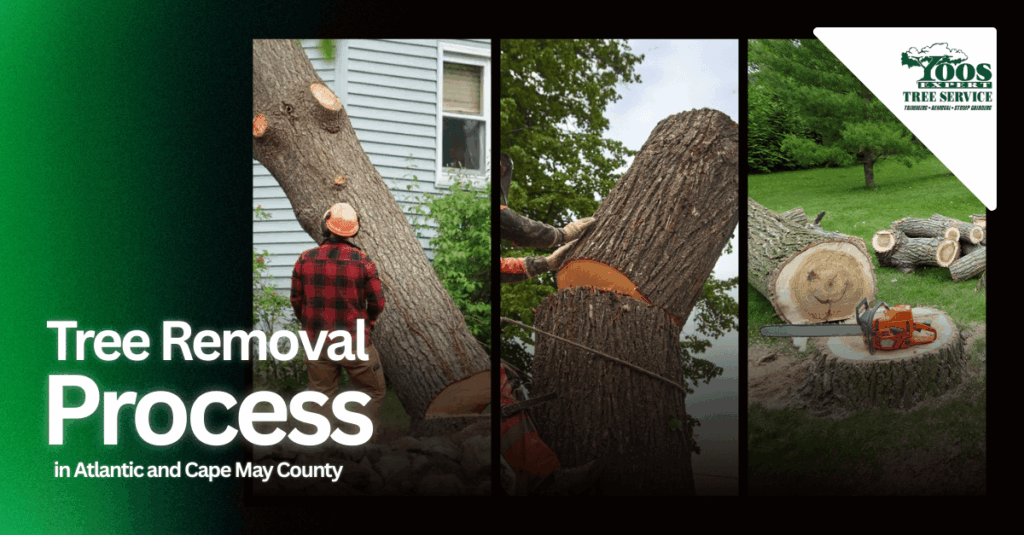
Tree removal is done section by section:
We climb or lift to the canopy.
Branches are removed first to reduce weight and height.
Trunk is cut into chunks, often lifted down by crane.
Sections are lowered carefully to the ground to avoid impacts.
Debris is processed using wood chippers and trucks.
This process might take a few hours or a full day depending on size, weather, and accessibility.
After the tree is gone, you’ll be left with a stump. Some people leave it, but it can be a hazard or attract termites.
We offer stump grinding to flatten it below the soil. You can then reseed, replant, or mulch the area. We also:
Haul away branches and logs
Remove sawdust and chips
Rake the area smooth
By the end, your yard is clean, safe, and ready for what’s next.
Storms can strike any time here in South Jersey. We provide 24/7 emergency response across Atlantic and Cape May Counties.
If a tree is already down—or about to fall—we come out quickly with:
Emergency crews and chainsaws
Knuckle boom crane if needed
Insurance-ready documentation
Risk mitigation steps to prevent further damage
Speed and safety are the top priorities.
Costs vary depending on:
Tree height and diameter
Access and location (tight spaces cost more)
Risk level (near wires or homes)
Crane or rigging needs
Stump removal
For a deeper breakdown of pricing factors, crane fees, and stump grinding costs, check out our full article on Tree Removal Costs in Atlantic & Cape May County.
Tree removal is not your average DIY weekend job. It’s one of the most hazardous tasks in arboriculture, involving high-powered equipment, unpredictable tree behavior, and significant legal responsibility.
Whether you’re dealing with a storm-damaged pine in Ocean City or a leaning maple near your garage in Hammonton, hiring a licensed and certified tree expert is the smartest — and safest — decision you can make.
Here’s why.
Every year, homeowners across New Jersey suffer injuries or costly property damage from improperly removed trees. One wrong cut can cause a tree to fall the wrong way, hit a house, take down a power line, or worse.
Licensed professionals:
Understand load distribution and fall trajectory
Are trained in aerial rigging, sectional dismantling, and crane operations
Follow strict OSHA safety standards
Carry liability insurance and workers’ comp
If an uninsured contractor drops a tree on your roof or gets hurt on your property, you may be held liable. That’s a risk no homeowner should take.
In New Jersey, becoming a Licensed Tree Expert (LTE) requires meeting state-level qualifications in:
Arboricultural science
Tree biology and structure
Soil health and root systems
Tree risk assessment
Safe climbing and cutting techniques
Yoos Tree Service holds multiple LTE licenses (#443, #722, #723), meaning you’re working with highly vetted professionals — not just someone with a chainsaw and a pickup truck.
We’re also ISA-certified arborists, which adds an international layer of expertise through the International Society of Arboriculture — a globally recognized credential in professional tree care.
Trees in South Jersey — especially near the coast — grow in challenging conditions:
Sandy or clay-heavy soils
Salt air and moisture
High winds from coastal storms and Nor’easters
A licensed tree expert understands how these conditions impact root health, canopy weight, and trunk stability.
They know how to properly evaluate a Norway maple, a Bradford pear, or a southern red oak under local stressors — and how to remove them without damaging nearby property or root zones of surrounding trees.
In neighborhoods like Ventnor, Margate, or Northfield, lot sizes are tight. You often have trees growing close to:
Homes
Garages
Fences
Power lines
Pools or patios
A certified tree removal expert has access to specialized equipment like:
Knuckle boom cranes for precise lifting
Bucket trucks for high canopy access
Ropes and pulleys for rigging limbs safely
They use advanced techniques like zip-line lowering, blocking, and load-bearing rigging systems to take trees down piece by piece — without causing damage or injury.
Each township in Atlantic and Cape May Counties may have its own regulations around:
Tree protection zones
Historic tree designations
Size and species removal limitations
Licensed experts know the local municipal codes and can:
Assist in pulling the correct tree removal permits
Provide arborist reports if needed for your HOA or city
Coordinate with insurance companies for storm damage claims
Ensure you stay in compliance and avoid penalties
When you hire Yoos Tree Service, you’re hiring:
A fully insured and bonded team
Professionals with over 38 years of experience in South Jersey
A company that stands behind its work with integrity and transparency
Our long-standing reputation is built on trust — with residential clients, commercial property managers, municipalities, and storm response crews across the region.
Yes, we specialize in tight-access removals using cranes and precision cuts.
Absolutely. Call us 24/7 for fast response.
Yes, we offer stump grinding as an add-on service to every removal.
Most towns require one. We’ll help guide you through the process.
Whether you’re dealing with a dying oak or planning to clear space for a new patio, we’re here to help.
We proudly serve towns like:
📞 Call Yoos Tree Service at (609) 927-7185 or request a free estimate here.
Share: