Key Takeaway
If you’re planning to remove a tree in Atlantic or Cape May County, NJ, it’s critical to hire a licensed, insured tree service company that understands local laws and permit requirements.
Not all tree removals are legal without approval — many towns require permits, especially for healthy or large trees, or those near protected areas.
Working with an experienced company like Yoos Tree Service ensures the job is done safely, professionally, and in full compliance with state and local regulations, helping you avoid costly fines or damage.
Removing a tree isn’t just about grabbing a chainsaw and going at it. If you live in Atlantic County or Cape May County, NJ, there are important things to know — from who you hire, to what the law says about permits and protected trees.
Let’s walk through everything you need to know to make a smart, safe, and legal decision when it comes to tree removal in South Jersey.
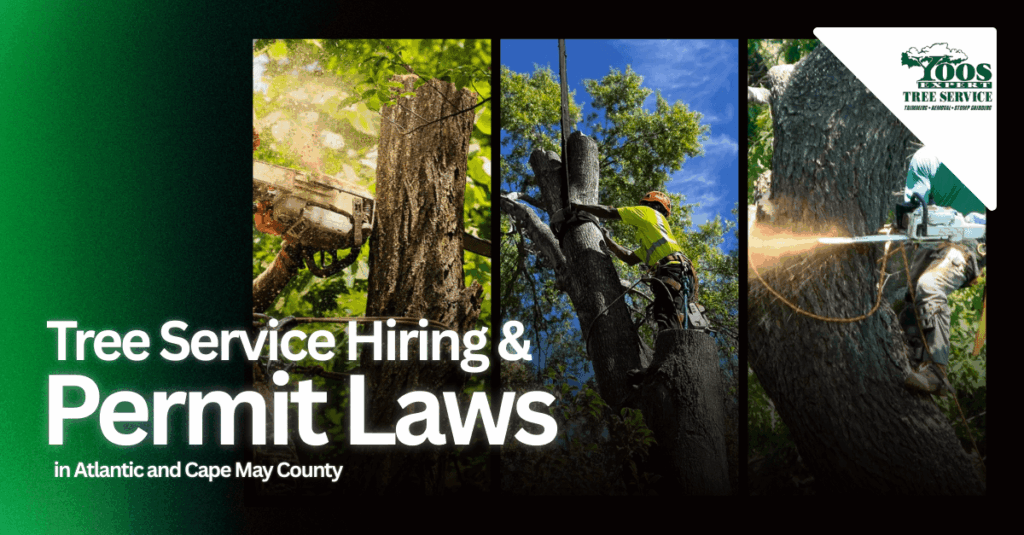

Removing trees might look easy, but it’s not. Big trees near homes, power lines, or roads can be dangerous. One wrong move, and you could end up with thousands of dollars in property damage—or worse.
That’s why hiring a professional tree service company is a must. These experts use specialized tools like knuckle boom cranes to safely remove trees, even in tight spaces. Plus, they know how to spot signs of disease, decay, and structural weakness that the average person might miss.
And if something goes wrong? A licensed, insured company carries liability coverage — so you’re not left holding the bag.
Hiring a tree removal company might seem straightforward, but not all providers are created equal. In fact, the wrong choice can cost you thousands of dollars in property damage, liability, or even fines for code violations.
That’s why it’s critical to know what qualifications, experience, and services truly matter — especially here in South Jersey, where coastal weather, dense woodlands, and strict regulations make tree work more complex than in other areas.
Here’s a complete breakdown of what to look for when hiring a tree service company in Atlantic or Cape May County:
Start by confirming that the company is licensed by the New Jersey Board of Tree Experts. As of 2017, New Jersey law requires any company providing tree care to hold a valid Licensed Tree Expert (LTE) or Licensed Tree Care Operator (LTCO) certification.
Why it matters:
It ensures the company has passed state-level exams on safety, biology, and proper tree care techniques
They are held accountable under NJ tree care law (N.J.A.C. 7:3A)
You can verify license status online or by asking for their license numbers (Yoos Tree Service holds License #443, #722, and #723)
Hiring an unlicensed company can not only result in poor workmanship—it may violate local ordinances.
An ISA Certified Arborist is someone who has passed a rigorous international exam from the International Society of Arboriculture and maintains continuing education. This is especially important when you’re not just cutting down a tree, but deciding if a tree can be:
Saved through cabling or bracing
Treated for disease or insect infestation
Pruned for structural health or storm safety
Look for companies that have one or more Certified Arborists on staff to assess your tree’s condition and make ethical, informed decisions based on science—not just convenience.
This is non-negotiable. Tree work is dangerous. It involves chainsaws, tall heights, falling limbs, and heavy machinery. If something goes wrong — and the company is not properly insured — you, the homeowner, could be liable.
Always request proof of:
General Liability Insurance (covers damage to your home, fence, car, etc.)
Workers’ Compensation Insurance (covers worker injuries on your property)
Surety Bonding, if required for public or HOA jobs
Pro tip: Ask for a Certificate of Insurance (COI) sent directly from the insurance provider — not just a printed PDF.
Tree work in South Jersey isn’t the same as it is inland. Many properties in Egg Harbor Township, Wildwood, Ocean City, and Hammonton are:
Exposed to salt spray and high winds
Built on sandier or flood-prone soils
Located in tree-dense developments or historic coastal towns
A company with deep local experience understands the types of trees common in this area — like sweetgums, pines, oaks, and black cherries — and how to work around tight spaces, power lines, and storm-damaged trunks.
Companies based outside the area may not be familiar with Cape May County’s coastal zone rules, which can result in fines or permit issues.
Storms don’t follow business hours — and neither should your tree company. In Atlantic County, wind events, coastal storms, and Nor’easters can bring down large limbs or entire trees overnight.
Choose a company that offers round-the-clock emergency services, including:
On-call crews ready to respond
Fast mobilization with proper safety protocols
Crane access for dangerous removals
Temporary tree stabilization until full removal is possible
Yoos Tree Service, for instance, has emergency crews available 24/7, even on holidays, to handle urgent tree risks or post-storm recovery.
Tree removal isn’t just about a guy with a chainsaw anymore. The right equipment ensures faster, safer, and less invasive service. Ask if the company owns or has access to:
Knuckle boom cranes (for precision removals near structures)
Bucket trucks or lifts (to safely reach high limbs)
Stump grinders (to fully eliminate leftover roots and tripping hazards)
Wood chippers and hauling trucks (for clean, eco-friendly disposal)
Having this equipment in-house often means lower costs and faster turnaround times for you.
Finally, check the company’s track record. Look for:
Verified Google and Yelp reviews
Before-and-after photos on their website or social media
Testimonials from local clients, HOAs, or city contracts
Membership in professional organizations (e.g., TCIA, ISA, NJ Shade Tree Federation)
Reputation isn’t just about star ratings — it’s about consistency, communication, and follow-through.
Before you sign anything, ask these key questions:
Do you offer free estimates? (Reputable companies like Yoos do.)
How do you handle trees near homes or power lines?
Can you remove the stump too?
What kind of insurance do you carry?
Will you handle the permit process if one is needed?
Do you have references or reviews I can check?
Asking these things helps you avoid low-quality companies or fly-by-night operations.
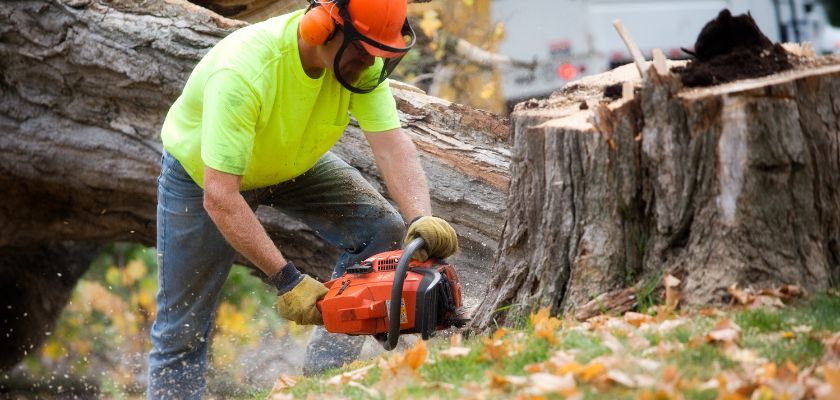
If you’re a homeowner in South Jersey, it’s important to know that tree removal is not always as simple as calling a company and cutting it down.
Across Atlantic and Cape May Counties, local townships have specific tree protection ordinances in place to preserve the area’s natural canopy, prevent flooding, protect wildlife habitats, and maintain the community’s character — especially in coastal and historic districts.
These laws aren’t just red tape — they’re designed to protect the environment, manage stormwater runoff, and ensure trees are only removed when absolutely necessary.
Most townships in these counties — including Ocean City, Northfield, Somers Point, Margate, Linwood, and Cape May City — have their own tree protection guidelines. These rules typically define:
Which tree species are protected (e.g., native hardwoods, heritage trees, or large oaks over a certain size)
When a permit is required for removal (especially for healthy trees, trees over a certain diameter, or those located near wetlands or public property)
How many trees you can remove per year
If replacement planting is necessary (you may be required to replant a certain number or type of trees after removal)
For example, in some towns, you may need a permit just to cut down a tree that’s more than 6 inches in diameter at breast height (DBH) — even if it’s on private property. Others might require a site plan or an arborist’s report before approving the work.
If your property is near coastal zones, tidal wetlands, floodplains, or historic districts, expect even tighter regulations.
These areas often fall under additional oversight from agencies like the New Jersey Department of Environmental Protection (NJDEP) or a local Historic Preservation Commission.
In Cape May, trees in historic areas may be part of the town’s architectural and visual heritage.
Near wetlands or dune areas, the removal of trees or even deep root systems may require an environmental permit or a review under NJDEP’s Coastal Zone Management Rules.
Removing trees in these zones without approval can result in stop-work orders, fines, or mandatory restoration, which may include planting new trees, shrubs, or even native grasses at your own expense.
You’ll likely need a tree removal permit in the following cases:
The tree is healthy and not a safety hazard
It exceeds a certain DBH (usually over 6–12 inches)
The tree is within a designated setback area or public right-of-way
Your home is within a coastal area, wetland buffer, or stream corridor
You’re removing multiple trees at once or doing land clearing for development
You’re working in a historic district
Some municipalities also require a tree removal mitigation plan, which includes how many and what types of trees will be replanted, and where.
Cutting down trees without following local laws can lead to serious consequences, including:
Fines ranging from $500 to $2,000 per tree
Legal action and forced replanting or restoration
A lien on your property for non-compliance
Difficulty obtaining future permits (for building, landscaping, etc.)
In some cases, insurance may not cover damages or liabilities if the work was done without proper approval.
Even if a tree looks dead or dangerous, don’t assume you can remove it without asking. Start by contacting your local township office, zoning board, or code enforcement department to see what permits or approvals are needed.
Some towns offer fast-track removal for hazardous trees, especially after storms, but you’ll still want that decision documented.
A reputable tree service — like Yoos Tree Service, which works across Atlantic and Cape May Counties — can help guide you through this process, identify what’s legal, and assist with any necessary paperwork.
You’ll usually need a permit if:
The tree is healthy and over a certain size (often measured in diameter at breast height or DBH)
You’re removing multiple trees at once
The tree is located in a protected zone (like a conservation area)
You’re near wetlands or water (where NJDEP may also get involved)
The property is commercial or part of a subdivision with HOA rules
If the tree is dead, dangerous, or storm-damaged, you may be allowed to remove it right away—but always document it with photos and get guidance from your township.
Hiring a tree removal company isn’t just about chopping down a tree—it’s a carefully planned process with safety, legality, and property protection in mind.
Here’s a complete walkthrough of what to expect when you hire a professional tree service in Atlantic or Cape May County, NJ.
The process starts with an on-site evaluation. A certified arborist or experienced tree technician visits your property to inspect the tree in question. They look at:
The species and size of the tree
Signs of disease, decay, or structural instability
Proximity to homes, garages, fences, sheds, or power lines
The terrain (e.g., sloped yard, tight space, soft ground)
Accessibility for equipment like knuckle boom cranes or bucket trucks
They may also evaluate if the tree can be saved through pruning, cabling, or bracing instead of full removal. If removal is the best or only option, they’ll move to the next step.
In many South Jersey municipalities, you can’t remove a tree without a permit — especially if the tree is healthy, large, or located near environmentally sensitive areas.
A reputable company will:
Check local tree ordinances (Egg Harbor, Ocean City, Cape May, etc.)
Determine if your property is in a coastal zone, wetland buffer, or historic district
Help prepare and file the permit application with the local zoning or environmental office
Provide supporting documents like an arborist’s report or site plan
Permits can take anywhere from a few days to several weeks depending on the township. Removing a tree without one can result in fines or legal issues, so this step is critical.
Once the legal side is sorted, you’ll receive a clear, written estimate. This typically includes:
Cost for tree removal (based on size, height, and complexity)
Additional charges for crane usage, traffic control, or tight access
Stump grinding or removal, if requested
Cleanup and haul-away services
Timeline and crew size
Transparent companies like Yoos Tree Service will explain each item so there are no surprises later. Ask for clarification if anything seems unclear or too broad.
After approval, the job is scheduled. Depending on the complexity of the work, you might be given a one-day or multi-day window. Here’s what happens behind the scenes:
Crew coordination and safety planning
Equipment preparation: cranes, ropes, chainsaws, wood chippers
Notification to utility companies if lines are involved
Traffic or pedestrian controls, if needed
You’ll be informed of any prep needed on your end — such as moving vehicles, outdoor furniture, or securing pets indoors.
On removal day, the crew arrives with everything they need. They begin by:
Setting up safety zones and equipment
Removing limbs from the top down using ropes or a crane
Lowering large sections of the trunk in a controlled descent
Chipping branches and cutting logs for haul-away or firewood
Special care is taken to protect nearby structures, landscaping, and underground utilities. Professionals use a methodical approach that’s efficient and minimizes risk.
Once the tree is down, you’re left with a stump — and stumps can cause problems. They attract termites, fungus, and may even regrow.
Stump grinding involves:
Using a powerful grinder to reduce the stump 6–12 inches below grade
Optionally removing large surface roots
Filling the hole with mulch or topsoil
You can plant over the area later, or leave it as is. Some towns may require stump removal as part of your tree removal permit, especially in public-facing areas.
Good companies leave your yard cleaner than they found it. After the work is done, the crew will:
Rake and blow away wood chips, sawdust, and debris
Load logs, branches, and grindings into their truck or trailer
Check for any damage to lawns or hardscapes
Walk you through the finished job
Some services offer to cut and stack logs for firewood, or leave behind mulch from the grinding if you’d like to reuse it in your garden beds.
At the end of the job, request:
A final invoice
A copy of the permit approval
Any before-and-after photos (useful for insurance or HOA)
A warranty, if offered (some companies warranty their work for a short period)
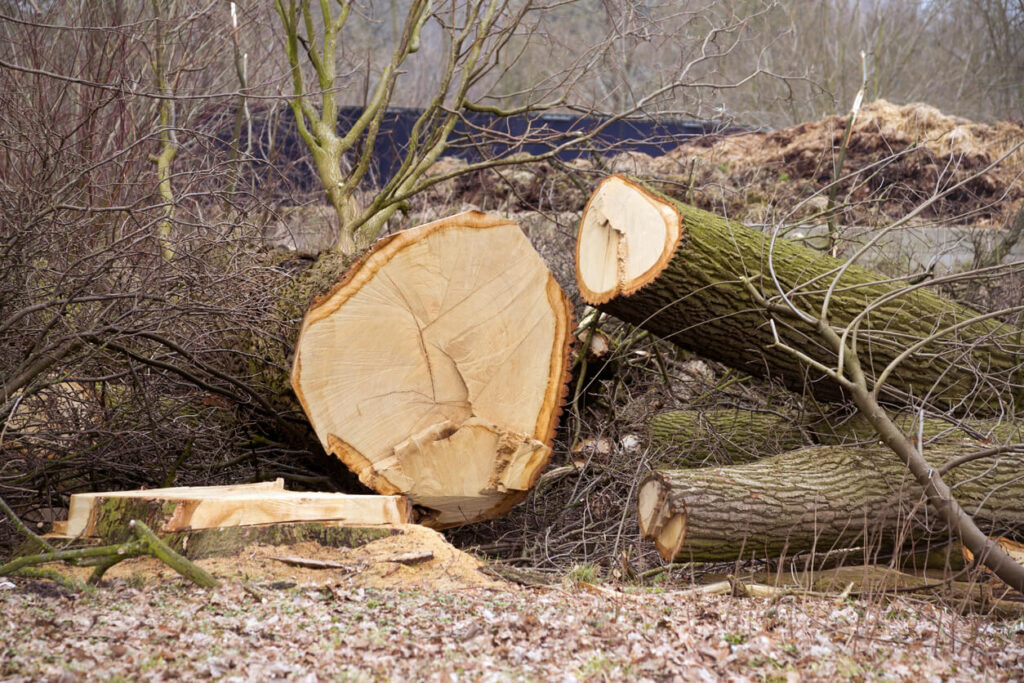
Cutting down a tree without proper authorization isn’t just a technical mistake it can lead to serious legal and financial consequences.
In Atlantic and Cape May Counties, NJ, many townships enforce strict tree protection ordinances, especially for healthy trees, trees near public roads, or those in coastal, wetland, or historic zones.
Whether you’re a homeowner, contractor, or landlord, ignoring these regulations can result in fines, forced replanting, and even civil disputes.
Here’s what you risk if you remove a tree without the required permit or documentation:
Many towns in South Jersey impose fines that range from $500 to $2,000 per tree removed without a permit. In some cases, the fine increases depending on:
The size and species of the tree (larger or protected trees can carry higher penalties)
Whether the tree was located in a restricted zone (e.g., near wetlands or a right-of-way)
Whether it was a first-time offense or a repeated violation
For example, cutting down a mature oak or maple without approval could cost significantly more than removing a small, damaged tree.
Some townships calculate fines based on Diameter at Breast Height (DBH) or require you to pay compensatory fees for canopy loss.
If tree removal is tied to a larger project—like building a home, pool, driveway, or garage—removing trees without a permit could result in a stop-work order from your municipality.
This means all construction on your property is halted immediately until the violation is reviewed and resolved.
These delays can stall projects for weeks and increase your costs in:
Labor rescheduling
Material storage
Equipment rental
Project management fees
Stop-work orders are typically issued by local code enforcement or the planning and zoning board, and they may not be lifted until compliance fees or restoration requirements are met.
Another common penalty is being ordered to replace the tree—but not always one-for-one.
Many municipalities require:
Replanting 2 or 3 trees for every 1 removed
Using native or equivalent species
Maintaining the new plantings for a set number of years
You may also be required to submit a tree restoration or replanting plan, often signed off by a certified arborist or landscape architect. These requirements can be costly, especially if the new trees must meet size, caliper, or spacing standards.
Failure to comply with replanting orders can lead to additional fines or legal action.
Illegal tree removal can trigger issues with your homeowner’s insurance, especially if damage occurs during the process or a neighbor makes a claim.
You may also face:
Denial of coverage for related incidents (e.g., tree falls during removal and damages a neighbor’s property)
Increased premiums after policy review
Trouble selling the home due to violation notices or unresolved code issues
A future buyer may demand remediation or price reductions if illegal tree work is found during due diligence or inspection.
If the tree was on or near a property line, you could also face civil legal issues. Trees that straddle boundaries are often considered shared property, meaning:
You need mutual consent before removal
Removing them unilaterally could lead to lawsuits for damages or trespass
You may be forced to pay for replacement, legal fees, or compensation for lost shade, privacy, or aesthetics
Neighbor disputes over tree removal can become long and bitter — even if the tree was on “your side,” the roots or canopy may have extended over their property.
Violations can become part of your municipal code enforcement record, making it harder to:
Pull future building permits
Win variance approvals
Work with HOAs or city planners
Some towns even list violations publicly on their websites or property records, affecting your reputation or slowing down future property sales.
For nearly 40 years, Yoos Tree Service has been helping homeowners and businesses in Atlantic and Cape May Counties with:
Emergency storm cleanup
Tree trimming and pruning
Safe, crane-assisted removals
Tree risk assessments by certified arborists
Stump grinding and full site cleanup
They’re not just licensed — they’re Certified Tree Experts, members of the ISA, and known for fair prices and fast response.
When it comes to something as risky as tree removal, experience matters. And Yoos has decades of it.
If you need help with tree removal in Egg Harbor Township, Ocean City, or anywhere in South Jersey, start with a free estimate. A good company will walk your property, explain what needs to be done, and answer all your questions.
You can contact Yoos Tree Service here to schedule yours.
Most jobs cost between $450 and $2,000, depending on size, location, and complexity. Trees near structures or power lines may cost more.
Yes, but it’s best to hire a pro with crane equipment to avoid damage.
If you live in a community with a Homeowners Association, check their rules first. Some require approval before removal.
It’s a flexible crane mounted on a truck that can reach over houses, fences, or tight spots — great for removing big or awkward trees safely.
Tree removal is not a simple weekend project. Between the legal steps, safety risks, and permit requirements, it’s something best left to certified experts.
Whether you’re dealing with a sick tree, planning a renovation, or cleaning up after a storm, knowing the local rules and hiring the right team makes all the difference.
If you’re in Atlantic or Cape May Counties, get peace of mind by working with a trusted name like Yoos Tree Service — licensed, insured, experienced, and always ready to help.
Share: